Wine Resources: Articles

Wine Judging Made Simple

Wine judging has been a bit of a mystery topic to me topic, but thanks to the Wine Judging Made Simple seminar at Sunday’s 36th Annual Virginia Wine Festival, I now have a great understanding of the process!

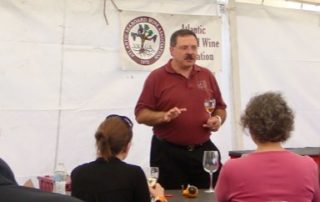
Walter Rachele, a graduate of the American Wine Society Wine Judge Training Program and judge in their commercial wine competitions, spent an hour with us on the basics of wine judging. After a brief helpful introduction, he led us through our first judging as a group using the standard U.C. Davis School of Oenology Scoring Sheet.  Then we judged three more wines at our tables.

Here’s how it works. The U.C. Davis Scoring Sheet is a 20 point system that judges wine on Appearance, Aroma(of the grape variety)/Bouquet (of the wine), Taste/Texture, Aftertaste, Overall Impression to get a total score.

  • 18-20 are Extraordinary = Gold Medal
  • 15-17 are Excellent = Silver Medal
  • 12-14 are Good = Bronz Medal
  • 9-11 are Commercially Acceptable
  • 6-8 are Deficient
  • 0-5 are Poor and Objectionable.

This is what the sheet looks like. To get you started on judging, you’re told what grape variety or varieties the wine is so you can judge appropriately.

I was extremely surprised how overall simple it is! It does require a basic understanding of each grape varieties classic characteristics (I used my cheat sheet on my iPhone from my session at the Wine Bloggers Conference in July) so you can accurately judge the wine. And you MUST leave your preferences at the door. I’m not an oakey chardonnay fan but I should still be able to judge the wine in the 5 categories above.

As the nose can get ‘tired’ smelling glass after glass, Walter shared a trick with us…run your nose along your arm to ‘clear’ the scents (note no lotions or perfumes are allowed).

Wine judging…a great way to increase your knowledge of wine, educate friends or even become a pro!

Tagged As:
, , , ,

Aromas of Wine: Describing Aromas & Using Them in Tastings

Wine contains thousands of scents and only a handful of tastes so aromas play a big part in wine tasting. The Aromas of Wine workshop at the fourth annual Wine Bloggers Conference taught us the facts behind how we get aroma from a wine and how we to describe aromas and use them in tastings.

Many people have difficulty describing aromas. There are the general terms of fruity, woody, earthy, herbal. As Dr. Ann Nobel, who created the Wine Aroma Wheel in 1984, says it’s difficult to describe aromas as there aren’t “primary aromas” like there are “primary colors” (red, blue, yellow) and with wines, we don’t have visual cues to help us describe the aromas we are getting. But we can learn more about the types of aromas we find in wines which will help us more easily pick them out and describe them.

Types of Aromas

First, there are three types of aromas in wine.

  • Primary: the actual grape aromas or youthful aromas; usually specific to grape varieties (i.e. Chardonnay grape has specific aromas)
  • Secondary: vinification / fermentation / oak aging aromas (i.e. oak or buttery aromas)
  • Tertiary: aromas from bottle age (i.e. leather or smokey aromas)

Classic Descriptors

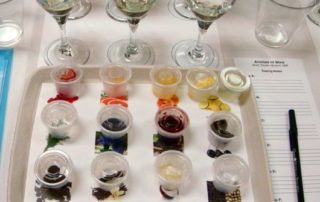
Second, there are classic descriptors for each type of grape, for winemaking processes and for maturation. These charts, used by Sheri Sauter Morano in the workshop, put it all together for me! Once you know these classic descriptors, it can help you discover more wines you like and help you if you ever do a Blind Tasting, like we did at the workshop.

Kits & Tools

Third, use different kits and tools to expand your wine aroma vocabulary.

  • The Wine Aroma Wheel: Using actual the actual item (a lemon, raspberry, piece of dark chocolate, etc…), you get the real smell and taste to go with the wine. Sheri Sauter Morano in our workshop used this process to lead us through a Blind Tasting (it paired with the facts above can make you a pro)!
  • L’Atelier du Vin Wine Tasting Kit: The Wine Discovery Kit is an illustrated tasting method with 40 wine aromas and 50 tasting. While focused on French wines its still a great resource for scents if you don’t want to get the real items every time.

In the end, all palates perceive wine differently. Our memory, experiences and expectations affect how we perceive wine as do our culture, age, gender and preference.  There is no right or wrong answer in wine tasting, but with a little more facts and practice in wine aromas, you can get more out of your tastings and look like a pro when tasting with your friends!

Cheers to the Aromas of Wine!


* special thanks to Sheri Sauter Morano for sharing her presentation so I could share more with you!

Tagged As:
, , , ,

Aromas of Wine: The Fun Facts

As as wine lover, I enjoy doing wine tastings and learning more to ‘hone my palette.’ Whatever that means!?! ;) I have two great wine tasting kits at home I’ve often used on my own and with friends to do wine tastings. They’re full of scents and we experiment to see what smell and taste we pick up in the wine. It’s a fun party game, but beyond that I haven’t mastered using the kits. Then a few weeks ago at the fourth annual Wine Bloggers Conference, I attended the Aromas of Wine workshop that put it all together for me!

This interactive workshop led by Sheri Sauter Morano, Master of Wine, and hosted by Winebow Wines taught us The Fun Facts behind wine aromas and How to Describe Aromas & Use them in Tastings. If like me, you’ve ever wondered what these scents were all about, read on.

The Fun Facts

When it comes to evaluating wine, our sense of smell is much more acute than our sense of taste. This is helpful as wine contains thousands of scents and only a handful of tastes. But to put it all together you need…

Smell + Taste + Touch

  • Smell: The receptor cells in our nasal lining (we have 350 different types) collect signals and send them to the olfactory bulb in our brain (the emotional part). The brain can recognize 10,000 different scents. Our sense of smell is hugely influenced by memory. Our ability to identify scents decreases with age, it increases with pregnancy.
  • Taste: The receptor cells on our tongue, aka taste buds, react to sweet, sour, bitter, salty and umami (or savory). We have 10,000 taste buds but we don’t all ‘taste’ the same. There are 3 categories of tasters…Supertasters (25% of us), Tasters (50%) and Non-tasters (25%). Taste is genetic. Women have more taste buds than men. Some people are more sensitive to sweet while others more sensitive to bitter.
  • Touch: The texture or mouthfeel.

= Flavor!

When tasting wine, we Swirl, Smell, Sip. Swirl to open up the wine, release more of the scents. Smell to take in the scents. Sip…when wine enters the mouth, it mixes with saliva which helps to vaporize the compounds and these compounds are not only tasted but also inhaled exposing more scents to our nasal lining receptor cells. So Smell + Taste + Touch = the Flavor you experience in a wine.

Next we’ll look at How to Describe Aromas & Use them in Tastings. Easier said than done!


* special thanks to Sheri Sauter Morano for sharing her presentation so I could share more with you!

Tagged As:
, , , ,

The Concise World Atlas of Wine

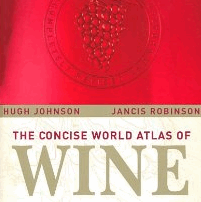
Doing some reading on Bordeaux wines (even after spending several days there last April, there’s still much to digest) and thought I’d share with you one of my great wine resources, The Concise World Atlas of Wine. Now in its sixth edition (published in September 2007), this publication first came out 36 years ago in 1971.

The Atlas, by Hugh Johnson and Jancis Robinson, goes in-depth on all the world’s main wine countries and regions. Its very fact based, not a ton on ‘tasting’ details but more overviews, and incredibly detailed maps of each region color coded and vineyards mapped. Very cool! I found it very helpful for my wine exploring trips to Bordeaux and Southern Italy last year. Its my go to book on my shelf as I’m very visual and like to see the country / region where the wines are located.

You’ll find France, Italy, Spain, Portugal, Germany, Rest of Europe (England/Wales, Austria, Switzerland, Hungary, Czech Republic, Slovenia, Western Balkans, Romania, Former Soviet Republics, Greece, Eastern Mediterranean, North Africa), North America (California, Pacific Northwest, New York, Southwest, Ontario; unfortunately no Virginia yet), South America, Australia, New Zealand, South Africa and a bit on Asia.

I discovered the Atlas in Florence last year but you can buy your very own copy on Amazon for a great price $19.59.

Tagged As:
,

What’s Your Wine Style?

Last month I was reading an issue of Food & Wine magazine at my girlfriend’s house and found this great  “Find Your Wine Style” quiz. It’s great if you’re new to wine or looking to try something new!

Which do you drink?

  • Whole Milk - Go for richer, more full-bodied wines – California Chardonnay for instance.
  • Skim Milk – You like lighter-style wines, such as Chablis.

Which juice do you prefer?

  • Grapefruit Juice – You like things with high acidity – for whites, that means varieties like Sauvignon Blanc and Riesling.
  • Orange Juice - You prefer sweeter, riper flavors so stick to Chardonnay or Viognier.

Which would you rather have on a steak?

  • Cracked Black Pepper – Try spicy Old World reds, like Syrah and other Rhône varieties.
  • Bérnaise Sauce – You want a lush, smooth California Merlot.

Which sounds more appealing?

  • Black Truffles – You’re a fan of earthy, funky umami flavors. Drink Pinot Noir, especially from the Old World.
  • Blackberries – You love fruit. New World reds are your thing: Australian Shiraz, California Zinfandel.

The on-line quiz has great pairing suggestions, suggested wines to try and great descriptions of each wine listed above.

Cheers!

Tagged As:
,