Champagne: Articles

The Wide World of Sparkling Wine

Champagne, Sparkling Wines … always make any occasion festive! But it is a very complicated subject. What makes Champagne, Champagne? And what’s the difference between Champagne and Sparkling Wine?

During our March Fine Wine Divas event, we set out to explore the subject. Here are some of the highlights and the group favorites.

What is Sparkling Wine?

Sparkling wine is a wine containing significant levels of carbon dioxide – making it fizzy. This carbonation may result from natural fermentation in the bottle or in a tank (see “How is Sparkling Wine Made?” below), or as a result of carbon dioxide injection.

Sparkling wine is usually white or rosé, but there are examples of sparkling red wine such as Italian Brachetto and Australian Sparkling Shiraz.

Types of Sparkling Wines

  • Champagne: The classic example of a sparkling wine is Champagne. This wine is exclusively produced in the Champagne region of France. While many other countries produce exceptional sparkling wines, they cannot be called “Champagne.”
    • Since 1985, use of the term “method champenoise” has been banned from all wines produced or sold in the European Union.
    • Blending is the hallmark of Champagne wine – usually involving a blend of Chardonnay (finesse and ability to age), Pinot Noir (body) and Pinot Meunier (fruit and floral notes).
    • The majority of Champagnes produced are non-vintage (NV, no year or vintage listed), but vintage Champagne is produced when the producers feel that the grapes from that year have the complexity and richness to warrant being on their own.
  • Crémant: Sparkling wines designated as Crémant (or, “creamy”) were originally named because their lower carbon dioxide pressure gave them a more creamy rather than fizzy mouth-feel.
    • French law dictates that a Crémant must be harvested by hand with yields not exceeding a set amount for their AOC. The wines must also be aged for a minimum of one year.
    • The Loire Valley is France’s largest producer of sparkling wines outside of the Champagne region.
    • The designation “Crémant” is not limited to use within France, and other EU countries that fulfill the production criteria may use it.
  • Prosecco: Prosecco is an Italian sparkling white wine made from Glera grapes.
    • As opposed to champagne, Prosecco is almost always made by the Charmat, or “tank method.” Large steel tanks keep the wine under pressure to capture the fresh fruitiness of the prosecco grape.
    • Prosecco can be either Spumante (more bubbly) or Frizzante (less bubbly), but the taste is usually Dry or Extra Dry.
  • Cava:  Cava is Spanish white or rosé sparkling wine produced mainly in the Penedès region in Catalonia (southwest of Barcelona).
    • Cava is produced in the method champenoise, but includes grape varieties different than those used to make Champagne.
    • In 1872, Cava was first created by Josep Raventós after seeing the success of the Champagne region.
    • Cava can be produced in six Spanish wine regions, and must be produced in the traditional method utilizing a combination of the following grapes: Macabeu, Parellada, Xarel-lo, Chardonnay, Pinot Noir and Subirat.

How Is Sparkling Wine Made?

  • The Traditional Method: The classic way is the méthode traditionelle (traditional method), or méthode Champenoise (Champagne method), developed in Champagne, France. Wine is produced in the normal way, then bottled with a sugar and yeast mixture to sit for a second fermentation. Carbon dioxide is produced during this fermentation creating the tiny bubbles. The yeast cells die and sink to the bottom of the bottle, referred to as the lees. While the wine is aged on the lees, complexity in the flavor develops (Champagne requires a minimum of 15 months for this second fermentation). Next the sediment is removed through ‘riddling,’ the tilting of the bottle on riddling racks to allow the sediment to move to the neck. The neck is then frozen, the cap removed, the plug of frozen sediment shoots out from the pressure. The bottle is then topped up with dosage (small amount of sugar solution, amount added varies based on sweetness and dryness levels desired), recorked and wire caged. Whoosh! Quite a process. Now you know why Champagne is expensive!
  • The Charmat Method: This method, also known as the Italian method, is quicker and used to make many less expensive sparkling wines. In this process, the yeast and sugar are added to the wine in the pressurized stainless steel fermentation tanks.Then this wine is bottled.

For our Fine Wine Divas event, we tasted the following 8 Sparkling Wines:

  • Baby Prosecco Veneto IGT, Veneto, Italy ($10)
  • NV Codorníu Anna de Codorníu Cava Brut, Catalonia, Spain ($16)
  • 2008 Trump Sparkling Rosé, Virginia, USA ($29)
  • 2008 Argyle Willamette Valley Brut, Oregon, USA ($25)
  • J Cuvée 20 Brut (NV), California, USA ($28)
  • NV Louis de Sacy Brut Grand Cru, Champagne, France ($37)
  • 2006 Marguet Pere et Fils Grand Cru Brut Champagne, France ($50)
  • 2010 Inniskillin Sparkling Ice Wine, Ontario, Canada ($70)

And the evening’s favorites were…

J Cuvée 20 Brut (NV)

  • Variety: 49% Chardonnay, 49% Pinot Noir, 2% Pinot Meunier from Russian River Valley, California
  • Aroma: Nose of lemon peel, honeysuckle, and delicate yeast.
  • Taste: Flavors of apple, grapefruit, angel food cake and almond. Balanced acidity.
  • Price:  $28 available on www.jwine.com
  • My thoughts: Judy Jordan has developed an amazing wine here, and in the Sparkling Rosé they have. Founded in 1986, Judy started the company after working for her father’s Jordan Winery. You can taste the care put into the wine…grapes are hand-harvested and pressed in a special gentle press.


2008 Argyle Willamette Valley Brut

  • Variety: 63% Pinot Noir, 37% Chardonnay from Willamette Valley, Oregon
  • Aroma: Nose of pear, apple, citrus and brioche.
  • Taste: Flavors pear, Meyer lemon and toasted bread.
  • Price: $25 available from Argyle Winery
  • My thoughts: With Oregon known for its incredible Pinot Noir, it’s not surprising to find this incredible Sparkler there. Argyle has produced world-class, award-winning Champagne-style Sparkling Wine since 1987.

2010 Inniskillin Sparkling Ice Wine

  • Variety: 100% Vidal Blanc, Niagara Peninsula, Ontario, Canada
  • Aroma & Taste: Nose and flavors of peach, apricot and honey.
  • Taste: Tropical fruits and honey.
  • Price: $80 available from Inniskillin
  • My thoughts: Ice wine is created by leaving the grapes on the vine into the winter months in order to concentrate the flavors. This wine packs a sweet punch but it’s a perfect after dinner drink.

While many in the group liked the Marguet Pere et Fils Grand Cru Champagne, the majority of the likes went to the above three. Nice work North America!

For more on tasting of Sparkling Wine, see Around the World of Sparkling Wine. And check out this great Sparkling Wine infographic.

Cheers to the world of Sparkling Wine!


Tagged As:
, , , , , , , , , , , , ,

Around the World of Sparkling Wine

I’m always a big fan of sparkling wine, special occasion or none. And the holidays are the perfect time to bring out ANY bubbles.

Last week, I attended an “I Brake for Bubbly” tasting at The Curious Grape, a local wine bar and shop, for a great tour through the sparkling wine world….Austria -> Chile -> France -> Spain -> California -> Italy.

Through this tour you’ll see what makes Champagne, which can only come from Champagne, France, so special, and what the climate, grape varieties and process create for sparkling wines from other regions and countries.

First a little overview about how sparkling wine is made.

  • The Traditional Method: The classic way is the méthode traditionelle (traditional method), or méthode Champenoise (Champagne method), developed in Champagne, France. Wine is produced in the normal way, then bottled with a sugar and yeast mixture to sit for a second fermentation. Carbon dioxide is produced during this fermentation creating the tiny bubbles. The yeast cells die and sink to the bottom of the bottle, referred to as the lees. While the wine is aged on the lees, complexity in the flavor develops (Champagne requires a minimum of 15 months for this second fermentation). Next the sediment is removed through ‘riddling,’ the tilting of the bottle on riddling racks to allow the sediment to move to the neck. The neck is then frozen, the cap removed, the plug of frozen sediment shoots out from the pressure. The bottle is then topped up with dosage (small amount of sugar solution, amount added varies based on sweetness and dryness levels desired), recorked and wire caged. Whoosh! Quite a process. Now you know why Champagne is expensive!
  • The Charmat Method: This method, also known as the Italian method, is quicker and used to make many less expensive sparkling wines. In this process, the yeast and sugar are added to the wine in the pressurized stainless steel fermentation tanks.Then this wine is bottled.

Now onto the tour…

Flight 1: Austria for Riesling Sekt

Sekt is the name used for sparkling wine in Germany and Austria. Both wines we tasted are from Weingut Steininger, a small family-owned winery in the Langenlois Valley of Kamptal, one of Austria’s northernmost growing regions. This is a very interesting tasting to compare…

  • 2009 Steininger Riesling Sekt, $25.99: The grapes for this wine come from the lower part of the slopes and a nutrient rich soil. It’s 100% Riesling grapes made using the Traditional Method and aged on the lees for at least one year. The result is a bready nose and apple flavors. Very nice!
  • 2008 Steininger Riesling “Heiligenstein” Sekt, $51.99: Heiligenstein means Holy Stone and is among one of the world’s most famous vineyards for Riesling. It’s very high altitude vineyards, grown on steep terraces of solid rock. First fermentation for this wine in neutral oak casks is one year, then aged on the lees for two years. No dosage is added. It produces a more concentrated sparkling wine with minerality and stone-fruit with bigger bubbles. A real treat!

Flight 2: Chile & France for Chardonnay-based Sparklers

  • 2011 Cono Sur Brut, Bío Bío, Chile, $18.99: This is a quite nice entry level sparkler made of 90% Chardonnay, 6% Pinot Noir and 4% Riesling. You wouldn’t expect a sparkling wine from Chile, but this one comes from the very southern part of the country, with sunny yet cold weather perfect for growing sparkling wine grapes. While made using the Charmant Method, they age the base wine for four months in barrel before second fermentation, then allow the wine to rest on the lees in tank for three months before bottling. Very balanced with nice minerality!
  • Non-Vintage Pierre Moncuit Blanc de Blancs Champagne “Hugues de Coulmet” Brut, Champagne, France, $51.99: Pierre Moncuit is a small boutique producer dating back to the 1940s. Their 36 acres of Grand Cru Village are in the the southern part of the region, which produces some of the region’s best grapes as they are grown in very chalky soil, giving great minerality to the wine. Although this is non-vintage, all Pierre Moncuit’s are made with single vintage grapes. Aged three years for second fermentation in the bottle before disgorgement. Very special boutique Champagne!

Flight 3: Spain & California for Red Grape-based Sparklers

  • Non-Vintage Canals Canals Cava Brut Nature Rosat Reserve, Penedes, Spain, $15.99: Cava is sparkling wine in Spain. Cava mainly comes from Penedes region. Cava is made with Spanish grapes using the Traditional Method. This wine is made from Garnacha, Monastrell, Trepat and Pinot Noir. Reserva in Spain means it’s been aged at least 15 months. Brut Nature means no sugar is added to the dosage. Ths wine has been aged 24 months in second fermentation. Very nice!
  • 2008 Gloria Ferrer Blanc de Noirs, Carneros, California, $21.99: Carneros is the cold end of the Sonoma and Napa Valley. Founded by Spain’s Freixenet, the second oldest Cava house dating back to 1889 in Spain, they started Gloria Ferrer and planted the first grapes in 1980. Made with the Traditional Method from 92% Pinot Noir and 8% Chardonnay and aged 18 months on the lees, there is also 5% non sparkling rosé added to give it the pretty pink color and creamy round texture. Lovely subtle strawberry and vanilla notes.
  • Non-Vintage Roederer Estate Brut Rosé, Anderson Valley, California, $28.99: Roederer Estate Brut is the first California sparkling wine to be produced by Champagne Louis Roederer, the fine winemaker of France. The Anderson Valley is the coolest of California’s sparkling wine regions, also very wet so hard to ripen the grapes. This blend is 60% Pinot Noir and 40% Chardonnay with 5% non-sparkling Pinot Noir added for color. Roederer follows the common Champagne practice of holding a portion of each year’s harvest in “reserve” to enrich the non-vintage blend in any given year. This wine is made of 10-20% reserve wines aged in oak for roundness and aged 24 months on the lees. A Champagne like sparkler from California!

Flight 4: France & Italy for What’s Hot Now

  • 2010 Domaine des Nugues “Made by G,” Beaujolais, France, $19.99: This wine from the Beaujolais region is 100% Gamay grapes, however sparkling wines aren’t allowed to be labled Beaujolais, thus the name Made by G. These grapes are hand-harvested and fermented, then fermented again using Traditional Method for a few months on lees. No sugar is added, the sweetness coming just from the Gamay grapes.
  • 2011 Tenuata Il Falchetto Moscato d’Asti “Ciombo,” Piedmont, Italy, $17.99: As an Italian wine it is considered Frizzante, their main term for sparkling wines. This wine is made of 100% Moscato grapes and tank fermented. The grapes are grown in the Ciombo region on 25 year old vines. The results is a very intense, floral, honey wine with low alcohol. It’s a perfect after dinner offering.

And that was our flight around the world of sparkling. What’s your favorite sparkling wine?

Cheers to Bubbles!

Tagged As:
, , , , , , , , , , , , , , , ,

And the Moët Oscar Cocktail Winner is…

…the Moët Red Carpet Glamour!

Adam Seger of Chicago is the winner of the inaugural Moët Oscar Cocktail Contest held through the Moët & Chandon USA Facebook page. His Moët Red Carpet Glamour “captures the essence of Hollywood glamour with exquisite notes of heady cardamom and kaffir lime that develop a refreshing and harmonious taste. This winning cocktail was chosen for its modern combination of the Hum® botanical spirit with Moët & Chandon Imperial, which highlights the flavor profile of champagne and truly celebrates the elegance of the Academy Awards.”

The Moët Red Carpet Glamour cocktail and Moët & Chandon Imperial will flow generously at the 2012 Governors Ball, the after-party of the 84th Academy Awards® this Sunday, February 26, 2012. This year the Governors Ball takes on a new spin. Special events producer Cheryl Cecchetto created an open format allowing the Ball’s 1,500 guests (Academy Award® winners and nominees, show presenters and other telecast participants) to circulate among a variety of seating configurations while enjoying the cuisine created specifically for the event by master chef Wolfgang Puck.

The 2012 menu created by Puck and Chef Matt Benciveng features more than fifty dishes, from one-bite hors d’oeuvres to small-plate entrees that will be passed throughout the evening. It includes signature favorites such as smoked salmon Oscars®, chicken pot pie with shaved black truffles, and Pastry Chef Sherry Yard’s gold-dusted chocolate Oscars alongside inventive presentations such as lobster tacos with tomato and pickled Shallots, and beet salad with pistachio butter, burrata and citrus balsamic.

For your Oscar party at home, make your own Moët Red Carpet Glamour Cocktail…

  • Fill a chilled Champagne Flute 1⁄2 way with ice.
  • Stir 1 ounce of Fresh Squeezed Sour Mix and Hum® Botanical Spirit with fresh ice.
  • Strain into Flute to fill 1⁄2 way.
  • Top with Moët & Chandon Imperial.
  • Garnish with a Single Rose Petal.
  • Continually refresh as you wish with Moët & Chandon Imperial as the Champagne will float on top of the Hum Sour, but its effervescence will deliver Hum’s heady cardamom & Kaffir lime notes.
  • Fresh Squeeze Sour Mix Preparation: Combine 1 cup sugar with 1 cup water until sugar is completely dissolved. Add 1 cup fresh lime juice and 1 cup fresh lemon juice and refrigerate.

Other new tools for planning your Oscar party…

  • Evite’s Postmark Invitations: Marc Friedland, designer of the Academy Award winners’ envelope, created the first-ever collection of Academy sanctioned invitations for Oscar Sunday viewing parties for Evite’s new premium site Evite Postmark. The Oscar Collection by Marc Friedland has ten designs from classic golden age of Hollywood to modern, fun takes on Oscar. Each invitation has a matching designed envelope, custom stamp, and features the never before available Oscar statuette and the use the of the “official” Academy Awards title.
  • My Oscar Ballot: Develop your own prediction list and share with friends via Facebook.

Cheers to Sunday night Oscar Parties!

Tagged As:
, , , , , ,

Next Awards Show, New Wine List…the SAG Awards

Next up is this Sunday’s 18th Annual Screen Actor Guild Awards®. Red carpet festivities kick off with an official Taittinger Champagne toast. The Taittinger Moment will be hosted by Vitalie Taittinger, the Champagne House’s Artistic Director and heiress, and Matt Czuchry, ensemble nominee for “The Good Wife.” The SAG awards are another fun show as the ceremony takes place over dinner, celebrates film and tv, AND it only last two hours.

Champagne Taittinger, the only marquee family-owned and operated Champagne house, is celebrating its 12th year as the official Champagne of the Screen Actors Guild Awards. Champagne Taittinger’s Brut La Française NV will be served over dinner, on the red carpet, backstage in the green room and at the after parties.

Also celebrating their 12th year with the SAG Awards is Dry Creek Vineyards. This year the featured wine is their Cabernet Sauvignon, Endeavour, crafted from their estate vineyards in Dry Creek Valley, Sonoma, California. The 2006 Endeavour will be presented in a beautiful 1.5L magnum for each table at the awards show. Their 2010 Fumé Blanc will also be served with dinner. During the show, Dry Creek Valley Vineyards also hosts a complimentary tasting bar allowing SAG Awards guest to sample their 2007 Mariner and 2009 Foggy Oaks.

Dry Creek Vineyards also created a special 2008 SAG Awards Cuvée, Dry Creek Valley to celebrate their 10th anniversary with the awards show which was released in November. The wine is 81% Cabernet Sauvignon, 8% Merlot, 8% Malbec, 3% Petit Verdot. You can get your own bottle on their website.

The SAG Awards® ceremony will be simulcast live nationally on TNT and TBS on Sunday, Jan. 29, at 8 p.m. (ET) / 5 p.m. (PT) from the Los Angeles Shrine Exposition Center.

Cheers to Taittinger and/or Dry Creek Valley Vineyards…enjoy the show!

Tagged As:
, , , , ,

Tonight’s Golden Globes = 10,000+ glasses of Champagne & Wine

The 69th Annual Golden Globe® Awards airs tonight and kicks off the big awards season. Always my favorite awards show as it combines film, tv, awards, food, wine and champagne!

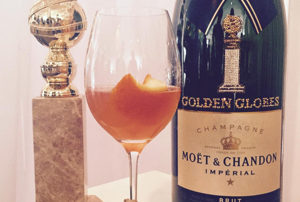
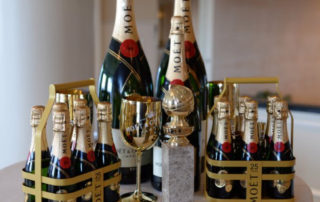
To celebrate there will be lots of bubbles from Moët & Chandon, the official champagne of the Golden Globes for the 21st year. More than 1,000 mini bottles and 500 magnums of Grand Vintage 2002 Moët & Chandon champagne, specially created for the show, will be served on the red carpet and inside the Beverly Hilton Hotel’s International Ballroom at tonight’s event. That’s over 9,000 glasses of champagne at $84.95 a bottle ($84,950 worth of champagne)! And don’t forget the over 400 bottles of wine, 2,500 glasses, that will also be served.

Executive chefs Suki Sugiura and pastry chef Thomas Henzi have created an elegant and mouth-watering menu reflecting the global nature of the Golden Globes and it will take a team of 40 chefs and 110 kitchen staff members to prepare it on show day. It will include an appetiser of pistachio crusted pistou ravioli with wild arugula, smoked tomato, kabocha compote and burrata; a combination entree of miso and sake lees marinated pacific sea bass with grilled king oyster musroom and braised prime short rib of beef with porcini pine nut herb ragout in a light cream of sherry wine ginger tamari sauce with roasted fingerling potatoes, candy striped beets, baby bok choy and yellow baby carrots.

For dessert Chef Henzi will be serving a trio of chocolate delice almond crunch terrine and acacia honey, caramel and fresh berries, which will pair ideally with the Moët & Chandon Grand Vintage 2002 and the 23K edible gold Italian chocolates.

For your party open one of Moët & Chandon‘s many options… White Star Impérial (their flagship), Rosé Impérial (the Glamoruous Champagne), Nectar Impérial (the Daring Champagne) and Nectar Impérial Rosé (the Extravagant Champagne).

Cheers to the 69th Annual Golden Globes Party!

Tagged As:
, , , ,